Global legal intelligence and advisory company RSGI has published a study commissioned by Harvey on how law firms and corporate legal teams are using Harvey’s generative AI platform, based on anonymized interviews with 40 customers worldwide.
The report, “Defining the Impact of Legal AI: How Harvey Customers Realise Value”, paints a picture of a tool that has moved beyond pilots and is now embedded in day-to-day work across some of the world’s largest firms and legal departments.
RSGI’s findings land amid a broader wave of legal AI research, and its findings could apply more broadly to almost any legal AI tool.
For general counsel and law firm leaders, the report is an early data point on what “normal” AI adoption could look like in large, regulated environments - and where the business model pressure may emerge first.
By the numbers:
- 40 organizations took part - 29 law firms and 11 in-house legal teams, drawn mainly from North America, the UK and Europe, with additional participants in APAC and Latin America.
- Average monthly licence usage was 92%, with many firms scaling from small pilots to hundreds or thousands of licences within months.
- Over two-thirds of organizations reported measurable benefits within three months of implementation; more than a third saw them within the first month.
- At law firms, “power users” saved an estimated 36.9 hours per month on average, compared with 15.7 hours for standard users; in-house power users saved 28.3 hours per month, versus 11.8 for standard users
RSGI stresses that time savings are largely self-reported estimates rather than audited numbers. But the direction of travel - more usage, more fluency, more benefit - is consistent across the cohort.
What law firms are seeing: less drudgery, more client dialogue
Among firms, the most striking statistic is emotional, not numerical: 100% of participating firms agreed or strongly agreed that their lawyers would be upset or disappointed if Harvey access were removed.
Beneath that headline sentiment sit some clearer operational patterns:
- 93% of firms said Harvey reduced time spent on non-billable work.
- 83% reported improved client relationships.
- 80% said they can deliver work faster to clients when they use Harvey on a matter.
The most common use cases will be familiar to any large commercial practice: drafting, summarization, document review and data extraction, particularly in transactions and litigation. Translation emerged as a major driver of savings in non-English speaking markets, with firms reporting sharper, more consistent outbound English communications.
One recurring theme is where the “saved” time goes. RSGI’s interviews suggest lawyers are not working fewer hours; instead, they are reallocating time toward higher-value strategy, scenario planning and client engagement. In the words of one participant, the tool “helps with the hardest thing to see: what’s missing rather than what is already there.”
For senior partners, that extra bandwidth appears to be opening space for more substantive client conversations – including around pricing. For associates and trainees, the shift is more visceral. Several firms reported that junior lawyers “cheered” when Harvey access was rolled out more broadly, and some now use access to legal AI tools as a talking point in lateral hiring.
Inside the corporate legal department: speed and insourcing
In-house teams, by contrast, frame value in terms of speed and internal capacity. In the RSGI study, every in-house team agreed that Harvey helps them deliver advice to the business faster and reduces time on routine work.
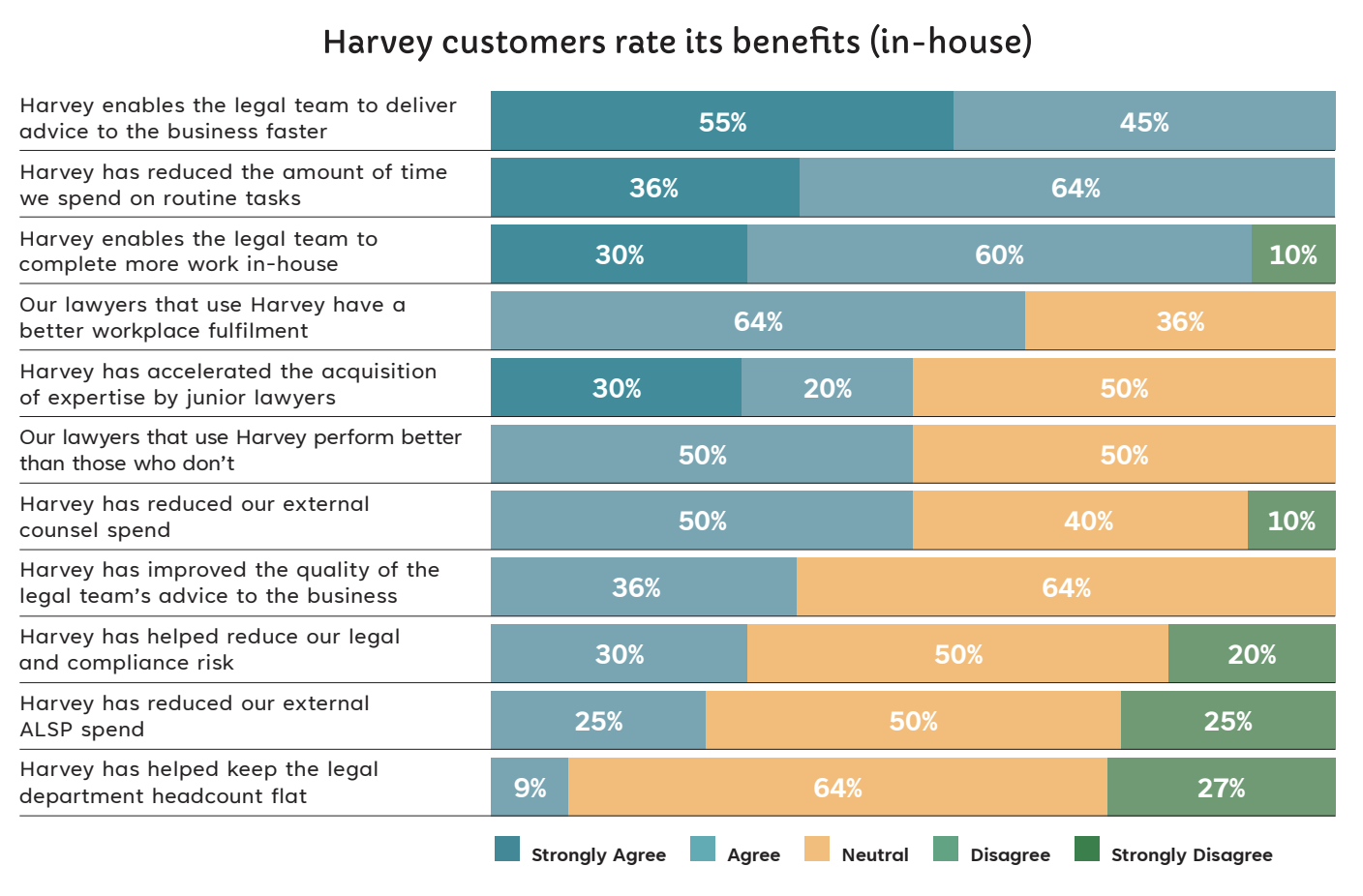
Nine out of ten reported that the platform allows them to take on more work in-house. In one large European legal department, a single high-value use case handled by one lawyer was enough to offset the cost of licences for the entire 30-person team.
Workflows are clustered around commercial contracting, M&A, regulatory and litigation support, along with translation and everyday drafting. Routine document review and data extraction from contracts are popular entry points because they lend themselves to measurement: baseline cycle times are known, and volume is high.
Several general counsel told RSGI they see Harvey less as a point solution and more as a platform: something that underpins a broader shift to a “do more with the same headcount” operating model. One GC described the goal as maintaining legal quality while making the service “feel faster” to business colleagues.
New pressure on fee models – but still early days
RSGI’s interviews suggest that Harvey is already nudging business models, particularly on the law firm side. Participants described a mix of current experiments and “on the horizon” plans:
- Fixed-fee and managed service offerings, such as A&O Shearman’s ContractMatrix and Vantage products, with AI as a key scalability layer.
- Subscription-style products built on Harvey’s Vault feature, for example cross-border data-transfer tools sold as ongoing services.
- First-pass due diligence services, where AI handles large-scale document trawls before human review.
- Workflow-based pricing in venture and emerging companies work, designed to keep mid-tier, standardised tasks within caps while preserving margins.
Clients are also changing expectations. Partners report that requests for proposals increasingly assume AI-enabled time savings and explicitly ask how firms will use those savings to reduce bills or reallocate effort.
That said, the billable hour is far from dead. Several firms told RSGI that clients still default to hourly billing even when alternative models are offered. For now, Harvey may be doing more to protect profitability under existing pricing structures – by cutting internal cost-to-serve – than to fundamentally change how matters are billed.
Culture and talent: the “human premium” argument
Beyond productivity, the report leans heavily into culture and talent. Across law firms and in-house teams, 83% of participants said Harvey has a positive impact on workplace fulfillment
The correlation appears strongest in firms that have been using Harvey for more than 18 months and have higher concentrations of power users. Lawyers in those environments report more energy, more time for complex analysis and, in some cases, a renewed sense of professional purpose as “drudge work” is automated away.
At junior levels, firms and legal departments are testing how AI intersects with training. About half of participants believe Harvey accelerates the acquisition of expertise by junior lawyers; the rest are neutral rather than negative, often because they are still formalising supervision and review models.
RSGI frames this as an opportunity to define a “human premium” – the skills that make lawyers valuable in an AI-enabled workplace: judgment, client empathy, complex negotiation, and the ability to design and supervise workflows rather than perform every step personally.
The power-user effect
A recurring pattern in the study is a “Harvey fluency curve.” As lawyers grow more comfortable with prompting, iterating and building workflows, their returns increase.
According to the chart on page 22 of the report, power users across the sample save more than twice as many hours as standard users, with several firms reporting individual lawyers who shave 20–40% off time spent on data-heavy matters.
Many organisations track not only whether a licence is active but how intensively it is used – queries per day, active days per week, recency of use – and then use that data to identify and support power users. Those lawyers, in turn, become internal champions, sharing concrete case studies that often do more to drive adoption than formal ROI decks
ROI: still more art than science
Despite the time-savings charts, RSGI is clear that formal ROI frameworks are still the exception. Only a minority of participants – six law firms and two in-house teams – have developed structured models to calculate returns from Harvey.
Instead, most organisations rely on a mix of proxy metrics:
- Adoption and usage: whether licences are used, and how often.
- Speed-to-first-benefit: how quickly lawyers report that Harvey helped on a live matter.
- Qualitative “anecdata”: internal stories about hours saved or matters won.
- Workplace indicators: retention, recruitment pull and internal satisfaction scores
In-house departments are somewhat further along in quantification, often because they already track legal operations metrics tied to business outcomes. Some teams have built detailed frameworks for specific workflows – for example, routine contract review – and are using those numbers to justify further investment in training and change management.
The caveat is obvious: the study is commissioned by Harvey, and all participants are paying customers. Even with RSGI’s independent methodology and anonymised interviews, the sample is heavily weighted toward early adopters that have already cleared internal hurdles on data security, ethics and procurement.
What GCs and law firm leaders should watch
For corporate legal leaders considering legal AI - whether Harvey or competitors such as CoCounsel, Legora, GC.AI, Vincent or others - the report offers a set of practical questions rather than definitive answers.
- Adoption and change management: Who are your potential power users, and how will you support them? The data suggests they drive outsized value and cultural change.
- Use cases: Which workflows combine high volume, repeatability and measurable baselines (for example, NDA review or commercial contract uplift) and are therefore easiest to track?
- Client expectations: For firms, how will you explain AI-enabled efficiencies in pitches and RFPs? For in-house teams, what do you expect of panel firms in terms of AI use and transparency?
- Training and supervision: How will junior lawyers use AI without hollowing out foundational skills? What review protocols and documentation will partners or senior counsel require?
- Risk and governance: How do vendor contracts, privacy controls and internal policies line up with your risk appetite - particularly if you are feeding sensitive client or employee data into an AI platform?
The bottom line: RSGI’s study shows that, at least for this cohort of early adopters, legal AI is no longer an experiment. It is infrastructure - imperfect, evolving and still hard to measure, but already shaping how major firms and corporates allocate work, structure teams and talk about value.
The harder question for the rest of the market is not whether to use tools like Harvey, but how quickly they can build the skills, governance and business models to keep up.