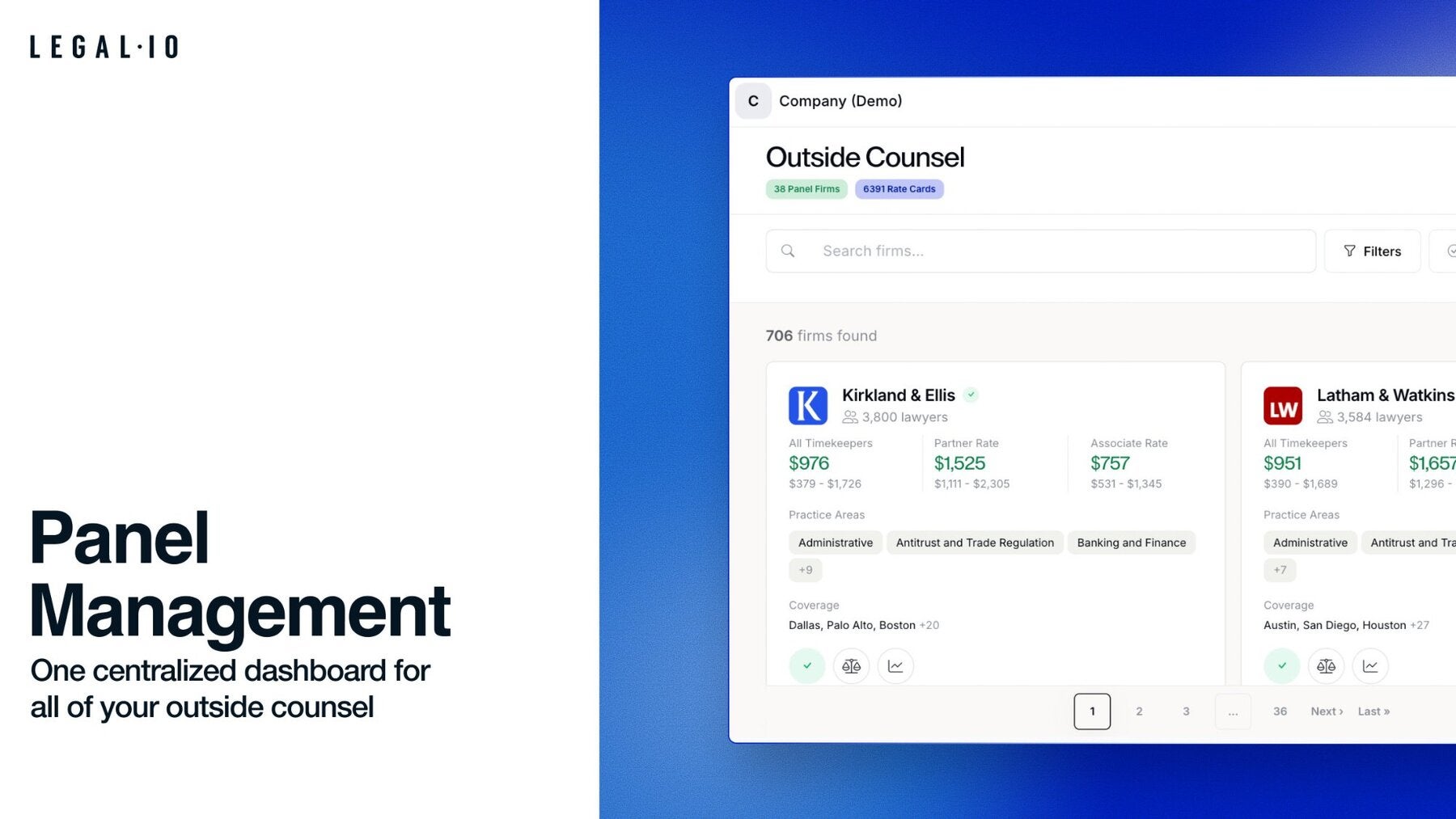
Introducing panel management as part of Legal.io's expanded Enterprise Platform. It gives legal teams a centralized view of their approved firms, making it easier for attorneys to find the right counsel and for operations teams to benchmark and oversee rates.
Anthropic's Claude legal plugin sent legal tech stocks into freefall in February 2026. A month later, legal AI leaders assess the real implications for law firms and in-house teams.
Mary O’Carroll, formerly at Google, Ironclad, and Goodwin, is now advising Sandstone, the platform that lets legal teams deploy AI agents in under 10 minutes for intake, triage, first-pass redlines, and drafting.
John Quinn, founding partner, discusses a proprietary AI tool, built on Anthropic, that can be used in litigation to prepare expert witness reports, examination outlines, etc.
A new global CIO survey finds board pressure on AI ROI has reached near-universal levels, with legal and compliance teams facing heightened scrutiny over AI governance and spend.
Partner billing rates at the 50 largest US law firms rose 16% last year, with some partners now commanding $4,000+ per hour. The data is forcing corporate legal departments to rethink outside counsel strategy.
Thomson Reuters' CoCounsel AI platform has crossed the one million user threshold, reflecting a broader and accelerating shift in how legal, tax and compliance professionals work — though the company's own CTO says the product is not yet where it needs to be.
A Manhattan judge's decision in United States v. Heppner delivers a clear warning to corporate legal teams: using public AI tools like Claude or ChatGPT for legal queries is not protected by attorney-client privilege or work product doctrine.
The Supreme Court ruled that IEEPA does not authorize sweeping global tariffs, opening potential refund pathways and prompting urgent review for corporate importers.