
(Image courtesy of Law.com)
Most firms have taken action recently to focus on ensuring their offices are more balanced when it comes to gender, sexuality, race, etc. And this trend is clearly reflected in the 2024 Diversity Scorecard, a measure of diversity in the legal industry, which indicates consistent gains across the sector in 2023.
The scorecard combines the evaluation of Women in Law and LGBTQ+ statistics with the Diversity Scorecard results as a whole. This approach, which evaluates firms based on their ability to attract, retain, and promote talent from underrepresented demographics, aims to provide a comprehensive view of diversity within the legal profession. This year, more than 200 law firms in the U.S. have been assessed in each of these categories, highlighting significant trends and identifying areas for improvement.
Trends on Diversity in U.S. Law Firms
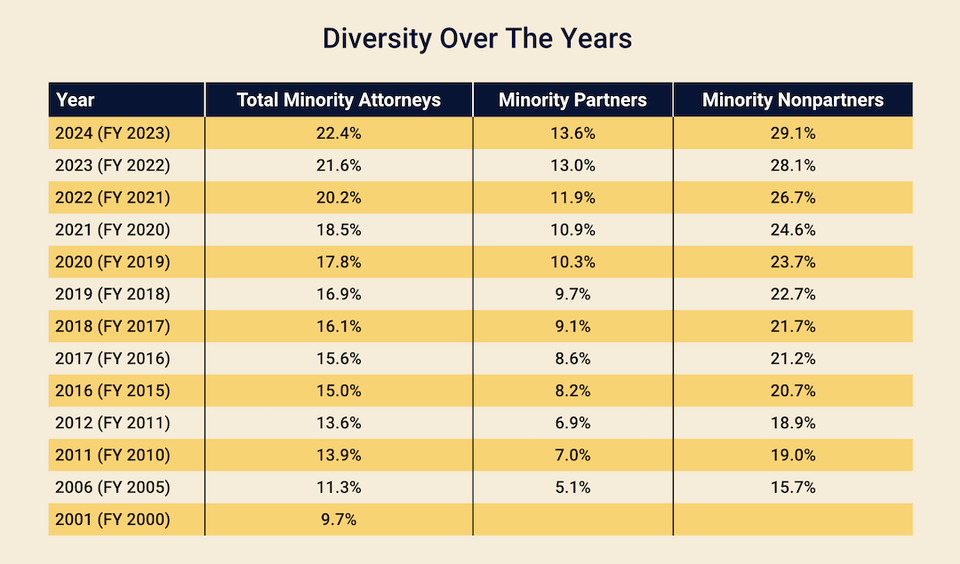
In the U.S., the Diversity Scorecard shows steady but incremental improvements in efforts within law firms. Minority attorneys comprised 22.4% of all lawyers in 2023, up from 21.6% in 2022. Similarly, minority partners increased from 13% to 13.6%. This gradual progress displays the persistent challenges and the need for ongoing efforts to enhance diversity at all levels within law firms.
Overall Minority Representation
The representation of minority groups within U.S. law firms continues to improve, though at a slower pace than in previous years. Minority lawyers now constitute 29.1% of non-partners and 13.6% of partners surveyed.
Leadership roles also saw gains, with minority representation in executive committees rising to 16.3% (up from 14.8%) and practice group chairs to 11.7% (up from 10%) of those firms who participated. These increases, while modest, reflect a growing commitment to diversity in leadership positions.
Minority Race Representation
African American attorneys now make up 4.3% of all lawyers surveyed, a slight increase from the previous year. However, their representation at the partner level remains stagnant at 2.5%. Asian American lawyers also saw modest growth, now representing 8.6% of all lawyers in the study, with 5% at the partner level and 11.4% at the non-partner level. Hispanic attorneys experienced faster growth, now representing 5.6% of all lawyers in this study, with a 0.3% increase overall. Hispanic partners rose to 3.6%, while Hispanic non-partners grew to 7.2%. This uptick is encouraging and indicates a positive trend for Hispanic representation in the legal industry.
Top Firms in Diversity
Fragomen, Del Rey, Bernsen & Loewy maintained their top position on the Diversity Scorecard, followed by White & Case and Berry, Appleman & Leiden. Significant movers included Cox, Castle & Nicholson, which climbed from No. 101 to No. 11, and Wachtell, Lipton, Rosen & Katz, which jumped from 174 to 92.
Women in Law
The Women in Law Scorecard highlights a growing correlation between firms with higher percentages of women associates and those with more women equity partners. In 2023, women made up 27.9% of partners, 50.2% of associates, and 42.1% of "other" categories of attorneys.
Despite these gains, there are still significant "leaks" in the talent pipeline, with fewer women advancing to leadership roles. The top 25 firms in the Women's Scorecard, including Steptoe, which rose from 96th to 14th, outperformed others with 48.8% women attorneys and 38.2% women partners.
LGBTQ+ Representation
The LGBTQ+ Scorecard, newly integrated with the Diversity Scorecard, ranks 223 firms based on self-identified LGBTQ+ attorneys. New York's Selendy Gay Elsberg leads with over 15% LGBTQ+ representation, followed by Jenner & Block at 14%, and Beveridge & Diamond and Cleary Gottlieb Steen & Hamilton, both at nearly 10%. These firms emphasize inclusivity through both pro bono and billable work, reflecting a deep commitment to LGBTQ+ representation.
Overall Diversity in U.K. Law Firms
A separate Law.com survey analyzing diversity trends in 54 top U.K. firms revealed varying levels of LGBTQ+ representation among the participating firms. On average, LGBTQ+ partners comprised 3.08% of partnerships, similar to the national average of 3.2% reported in the 2021 census. Weil Gotshal & Manges topped the list with nearly 9% LGBTQ+ partners, demonstrating a strong commitment to inclusivity.
Top Firms
Other firms with notable LGBTQ+ representation included Stephenson Harwood (8.49%), Proskauer Rose (7.89%), and Shoosmiths (7.08%). Proskauer Rose also distinguished itself with the highest proportion of LGBTQ+ equity partners at 11.8%. Akin Gump Strauss Hauer & Feld was highlighted for its inclusive firm culture and high levels of LGBTQ+ representation across different seniority levels.
Experiences and Initiatives
Partners at top-ranking firms emphasized the importance of an inclusive environment. Christopher Marks of Weil Gotshal shared his experience of coming out within the firm, crediting the firm's inclusive policies and supportive mentors.
Weil's HR policies, including surrogacy and adoption leave, are designed to foster an inclusive workplace. Similarly, Akin Gump's Matthew Durward-Thomas highlighted the benefits of a respectful and visibly inclusive firm culture.
Industry-wide Observations and Challenges
Despite the overall positive trend in diversity, the growth remains sluggish, and significant challenges persist. In the U.S., women and minority attorneys continue to face barriers to reaching leadership positions.
The "motherhood penalty" and the generally heavier burden of personal obligations for women are notable obstacles. Firms must be intentional about retaining women and minority attorneys by providing support such as flexible work arrangements and parental leave policies.
The recent U.S. Supreme Court decision to ban race-based affirmative action in college admissions poses a risk to future diversity gains. Historically, such bans have led to a decrease in minority representation at law schools, which could impact the diversity pipeline for law firms.
A Clear Indication of the Right Efforts
The 2024 Diversity Scorecard illustrates the ongoing efforts and progress in enhancing diversity within the legal profession, both in the U.S. and the U.K. While there are significant gains in minority, women, and LGBTQ+ representation, the data also underscores the need for continued commitment and action.
Firms that invest in diversity at all levels, from associates to partners and those that create inclusive environments, are seeing the most progress. These efforts will be crucial in ensuring a more diverse and equitable future.