
Key points:
- MIT report finds $30–40B in enterprise AI investment, yet 95% of pilots show zero financial return.
- Only 5% of AI pilots deliver measurable value, highlighting the "GenAI Divide."
- Employees drive a “shadow AI economy,” often using consumer tools without employer approval.
A new MIT study, The GenAI Divide: State of AI in Business 2025, concludes that despite billions in investment, most corporate AI efforts are failing to produce business results.
The report, based on 52 executive interviews, surveys of 153 leaders, and analysis of 300 public AI deployments, found that 95% of pilots delivered no measurable P&L impact. Only 5% of integrated systems created significant value.
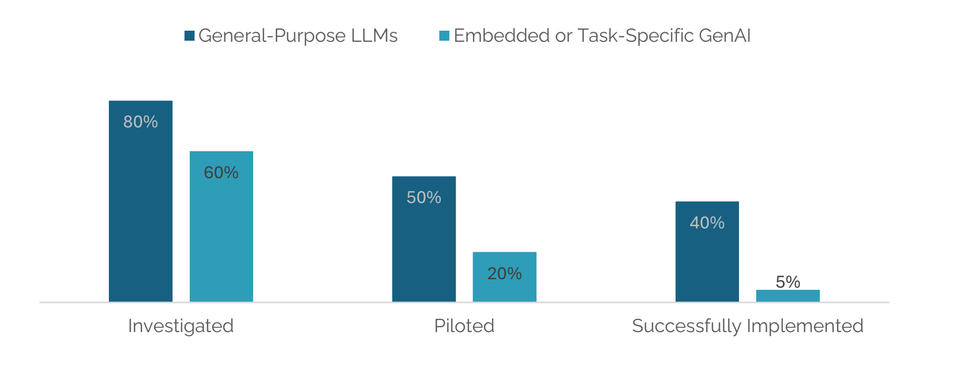
The findings highlight what the authors call the “GenAI Divide” - a split between high adoption and low transformation. While over 80% of organizations have piloted tools such as ChatGPT or Copilot, and nearly 40% report deployment, these systems mainly boost individual productivity rather than delivering measurable enterprise outcomes.
By contrast, enterprise-grade systems are being abandoned: 60% of firms evaluated them, but just 20% reached pilot stage and only 5% went live. “The hype on LinkedIn says everything has changed, but in our operations, nothing fundamental has shifted,” a manufacturing COO told researchers.
The study identifies four structural factors behind the GenAI Divide:
- Limited disruption: Only two of nine major sectors - Tech and Media - show material business transformation from GenAI use.
- Enterprise paradox: Large firms lead in pilot volume but lag in successful deployment.
- Investment bias: AI budgets overwhelmingly favor sales and marketing, despite better ROI in operations and finance.
- Implementation advantage: Tools built by external vendors succeed twice as often as internal builds.
The report also documents the rise of a “shadow AI economy.” While only 40% of companies have official LLM subscriptions, 90% of workers surveyed reported daily use of personal AI tools like ChatGPT or Claude for job tasks. These shadow systems - largely unsanctioned - often deliver better performance and faster adoption than corporate tools, highlighting what the report frames as a governance blind spot.
Worker sentiment reveals a preference for flexible, responsive tools. Even when internal systems use the same underlying models, users consistently favor personal AI accounts for their reliability and control. But when it comes to high-stakes work—legal documents, client communication - 90% still prefer human oversight due to AI's inability to retain memory or adapt to specific contexts.
Organizations that succeed in scaling AI share a few common approaches: they partner with vendors offering customized, learning-capable systems; they focus on workflow integration; and they deploy tools where process alignment is easiest - typically back-office functions like document automation, procurement, and risk review.
Back-office functions, while less visible to boards and investors, offer some of the highest returns. Case studies from the report show:
- $2–10M in annual savings by replacing outsourced support and document review.
- 30% reduction in external agency spending for marketing and content work.
- $1M annual savings in financial risk monitoring.
MIT researchers stress that the next phase of AI will be defined by Agentic AI—systems that remember, learn, and act autonomously. Protocols like NANDA and the Model Context Protocol are laying the groundwork for an “Agentic Web,” where AI agents coordinate across organizations and platforms, replacing many static SaaS tools.
“The GenAI Divide isn’t inevitable,” the report concludes. “But bridging it requires a fundamental shift—from building to buying, from central labs to empowered teams, and from static tools to adaptive systems.”