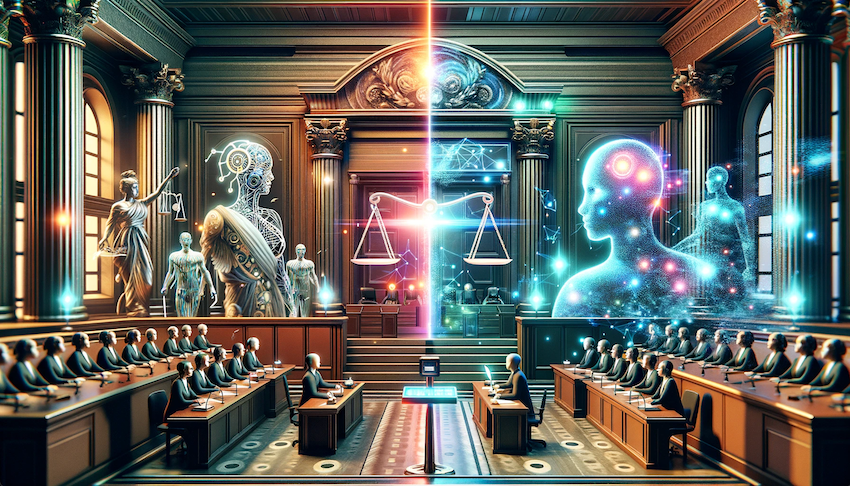
The winds of change are swirling through the hallowed halls of justice, propelled by the ever-evolving force of artificial intelligence (AI). In a recent year-end report, U.S. Supreme Court Chief Justice John Roberts urged "caution and humility" as the legal field grapples with this game-changing technology. But amidst the transformative potential, another storm is brewing: the murky waters of copyright law threaten to engulf the burgeoning AI industry in 2024.
AI Reshapes Legal Landscape
Roberts acknowledges AI's double-edged sword. He envisions a future where AI tools empower access to justice for the underserved, revolutionize legal research, and expedite case resolution. AI algorithms can scour mountains of legal documents, identify relevant precedents, and even predict judicial outcomes with surprising accuracy. This promises efficiency and cost savings, potentially democratizing access to legal services.
However, Roberts underscores the need for caution. He highlights concerns about privacy infringements, algorithmic bias, and the inherent limitations of AI's "black box" decision-making processes. The question of human versus machine judgement looms large, as entrusting crucial legal decisions solely to AI remains a controversial proposition.
Copyright Crossroads
As AI tools grow increasingly sophisticated, the question of authorship becomes a legal minefield. Who owns the copyright to the creative outputs of AI programs? Is it the programmer, the user, or the AI itself? This has major implications for the AI industry, with billions of dollars in potential revenue hanging in the balance.
Currently, U.S. copyright law grants protection to "original works of authorship fixed in a tangible medium of expression." While AI-generated outputs often meet the criteria of originality and fixation, the "authorship" aspect remains contentious. Courts have denied copyright protection to works solely created by AI programs, arguing that lack of human intervention disqualifies them as original works.
"Just as a child learns language (words, grammar, syntax, sentence structure) by hearing everyday speech, bedtime stories, songs on the radio, and so on, a model 'learns' language by being exposed — through training — to massive amounts of text," Meta told the Copyright Office, in comments defending their AI training.
However, some argue that this interpretation stifles innovation and hinders the AI industry's growth. They advocate for recognizing AI as a collaborative tool, granting joint authorship to both programmers and the AI itself. This approach could unlock new revenue streams for AI developers but also raise concerns about ethical and commercial control over AI-generated works.
Copyright Law and AI Looking Ahead at 2024
2024 promises to be a pivotal year for the legal and AI communities, as the copyright debate heats up. Upcoming court cases and potential legislative changes could set precedents with far-reaching consequences. Navigating this labyrinth will require a collaborative effort from policymakers, legal scholars, AI developers, and the public at large.
Finding a balance between fostering innovation and protecting creativity is crucial. Clear and flexible copyright frameworks are needed to incentivize AI development while safeguarding intellectual property rights. Ultimately, ensuring responsible and ethical use of AI in the legal field will require careful consideration of both its transformative potential and potential pitfalls.