
(Image courtesy of ACC Law Department Management Benchmarking Report)
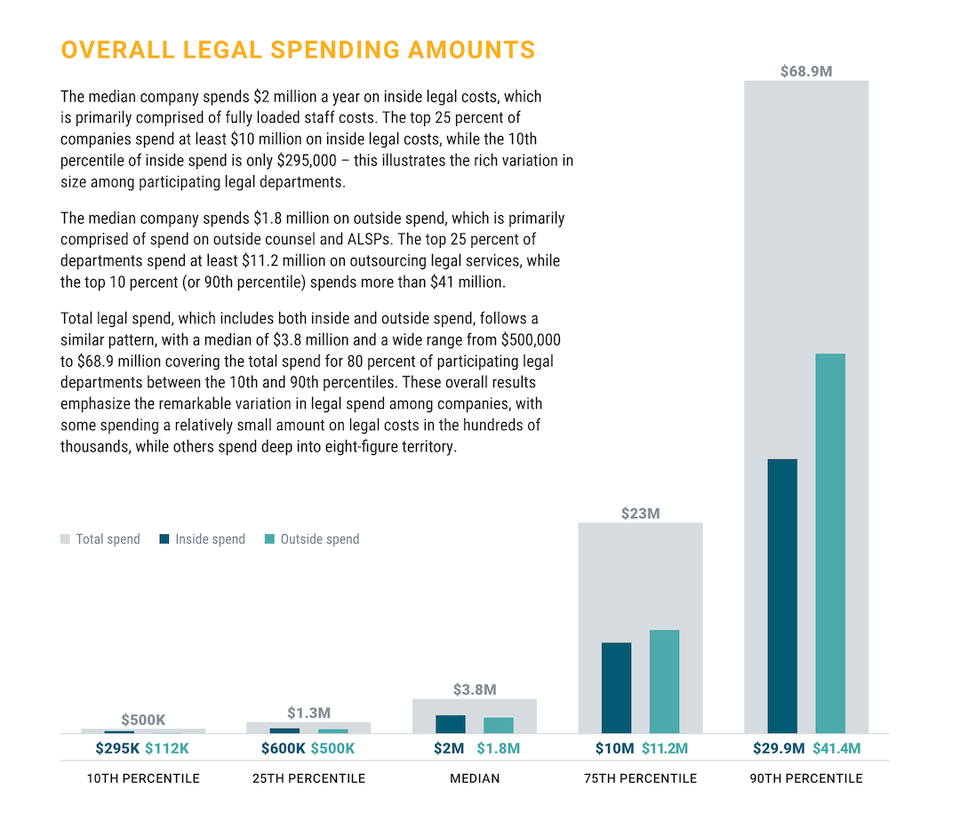
As legal departments are becoming more specialized to help companies navigate the complexities of the current business landscape, expenses associated with running in-house teams are also growing. According to The Law Department Management Benchmarking Report, prepared by the Association of Corporate Counsel (ACC) and Major Lindsey & Africa, legal departments at the median revenue level saw a 23% increase in spending, reaching $3.8M.
Inside vs. Outside Spend
The ACC survey, based on responses from 421 legal departments across 24 industries and 32 countries, revealed a consistent trend in legal spending, with companies directing the majority of their legal budgets to internal resources, such as all salary, tax and benefits costs for all legal department staff, as well as overhead and administrative costs.
In 2023, companies allocated 52% of their legal expenses to inside counsel, while 48% went to outside spend, which includes outside counsel and alternative legal service providers but not costs associated with fines, settlements, judgments or claims.
However, the ratio of inside to outside spend tends to vary based on company size and budget, with smaller companies with less than $1B in revenue relying more heavily on internal resources (56%), while bigger firms seem to favor outside counsel more, with companies with $20B or more in revenue spending equal amounts on in-house and outside counsel.
“Larger companies might have more complex legal needs and ongoing regulatory requirements, thus relying more on outside resources and expertise. Additionally, their financial resources might allow them to both invest in building and maintaining a strong legal department and outsourcing plenty of work for more complex and specialized need,” the report explains. Smaller companies may have more limited needs, which means they would only resort to outside counsel only for very specific matters.
Higher Spending Reflects Increase in Responsibilities
The survey found that overall legal department spending increased across the board, ranging between a median of $6M in companies with $1B - $5B in revenue, to almost $32M in companies with $5B - $10B in revenue.
The survey found that companies with revenue between $1B - $5B spent a median of $6M on legal, while those with revenue between $5B - $10B spent almost $32M. However, legal spend as percentage of company revenue decreased slightly from 0.6% in 2022 to 0.5% last year.
The increase in spending reflects the vast increase in responsibilities and duties of in-house counsel in recent years, who are now tasked with guiding their companies through new challenges in the business world, ranging from post-pandemic employment to privacy and compliance issues and the incorporation of new technologies such as artificial intelligence in modern business practices.
“We continue to see the responsibilities of an in-house legal professional further evolve as they grapple with new challenges around the advent of burgeoning technologies like AI,” said Lee Udelsman, a Managing Partner of Major Lindsey & Africa. “As a result, we’re seeing increased specialization particularly in terms of legal tech spending, as in-house legal departments maintain a growing focus on compliance and privacy issues.”
Legal Tech Spend Growing at Slower Pace
Expenses associated with the adoption and implementation of legal technology are also growing, albeit at a slower rate. Roughly 53% of legal tech spending is contained within legal departments’ budgets, especially in companies that have under $5B in revenue. However, larger companies with over $5B in revenue tend to favor a split approach, where the legal tech budgets are shared between legal departments and other business functions.
This is largely due to the fact that larger companies have a more centralized approach to technology acquisition and implementation. “There are half a dozen different technologies that are in the process of being integrated and streamlined. And until that happens, you’re not going to see wholesale adoption,” Udelsman explained.
As for the types of tech being adopted, the ACC survey shows that e-signature and contract management software to be the most popular (71% and 59% respectively), indicating a growing focus on streamlining agreement processes.
There is also a growing adoption of specialized technology, with compliance office tools (37%), matter management systems (36%) and AI-powered solutions (34%) being the most popular.
Overall, as the average company nowadays uses six different legal tech tools, it is largely up to in-house counsel teams to guide the adoption of these technologies, resulting in a significant shift in duties and responsibilities and a likely continued trend of higher legal department spending across all industries.