
Key Takeaways
- Thomson Reuters has unveiled the Relative Performance Measure to better assess lawyer productivity.
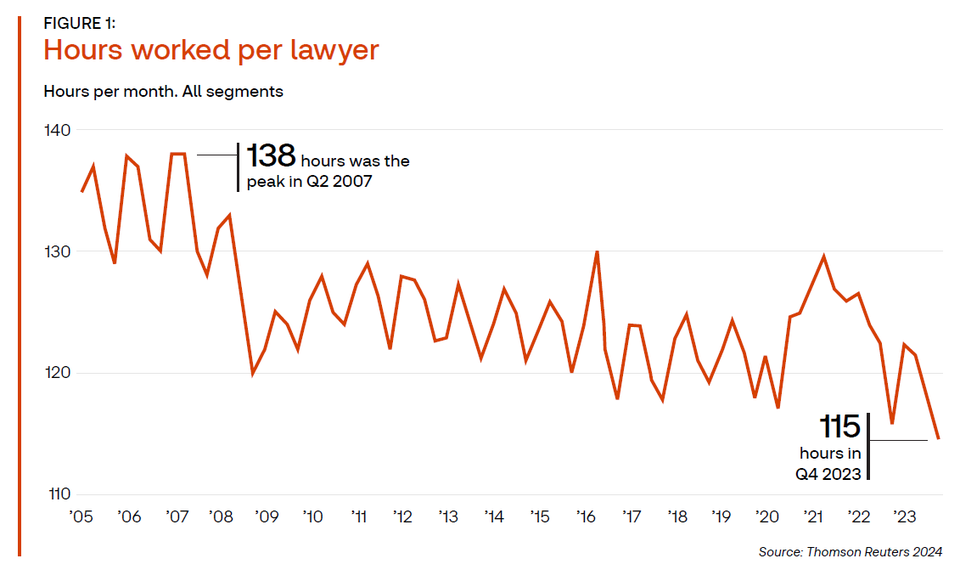
- Average lawyer productivity has decreased over the years, with billed hours dropping from 138 hours/month in 2007 to 115 hours in late 2023.
- The RPM draws inspiration from baseball analytics, aiming to provide a more nuanced view of lawyer contributions.
Thomson Reuters Institute has announced a new metric, the Relative Performance Measure (RPM), designed to more accurately gauge the true value of lawyers’ work — not just the time they spend on it. RPM measures a lawyer’s relative performance in generating fees and collecting them, compared to their peers in the same segment, practice group, office location, or lawyer-title class, according to a Thomson Reuters press release.
This initiative responds to ongoing concerns within the legal industry about declining productivity, as traditional metrics like billable hours fail to capture the full scope of a lawyer’s value.
Key takeaways of the Thomson Reuters report:
-
The new metric is more aligned with the outcomes and profitability of legal work, rather than the inputs and hours.
-
The metric is future proof, being able to account for different pricing arrangements, being more resilient to macro-economic factors, and more adaptable to the impact of AI in the sector.
Decline in Lawyer Productivity
Over the years, lawyer productivity has shown a significant decline. According to Thomson Reuters, the average number of hours billed by lawyers has dropped from a peak of 138 hours per month in Q2 2007 to just 115 hours per month by the fourth quarter of 2023.

The RPM however can help law firms “diagnose and address the root causes of low-performing lawyers, such as poor collections, low billing rates or inefficient work processes,” the press release says.
Baseball as Inspiration
Interestingly, the RPM metric takes inspiration from baseball, where productivity is often measured by player performance as compared to a standard “replacement-level” player in the position, Marcus Belanger, an analyst at the Thomson Reuters Institute, told Law.com.
“We thought: ‘What is the equivalent of that for lawyers? What could we do to level the playing field?’ Because [hours] is a fundamentally flawed metric, susceptible to macroeconomic factors and other things outside of an attorney’s control,” said Belanger.
Steps for Calculating RPM
Firm profitability is becoming less tied to productivity, a trend that will likely accelerate as a result of generative artificial intelligence. This is why RPM is expected to be a better metric.
How does it work?
RPM is based on an average, or replacement-level, score of 1.00. Any score above 1.00 means the timekeeper, group, office or firm being compared produces an above-average output relative to peers.
For example:
An attorney with an RPM score of 1.32 is 32% better at producing relative to peers, while an RPM score of 0.87 would mean the attorney’s production is 13% lower, relative to peers.
The exact calculation is proprietary, but Thomson Reuters outlines three general steps to consider:
-
Data Collection: Gather detailed data on individual lawyer performance, including billable hours, client feedback, and outcomes.
-
Comparison: Compare each lawyer’s fees collected to the average of their peer lawyers.
-
Computation: Compute the score by adjusting the value found in the first step by the value found in the second step.
The report concludes that RPM is not designed to be a one-size-fits-all metric or to replace tracking of the billable hour, but rather to offer a better way for firms to measure lawyer performance in the age of AI.