Large legal departments often rely on dozens, sometimes hundreds, of outside law firms. But when a new matter comes in, it is often surprisingly hard to answer basic questions: Which firms are approved? Who has the right expertise? What rates have been negotiated? And are we using outside counsel where flexible legal talent may be a better option?
Panel information is usually found on multiple billing systems, spreadsheets and in the institutional knowledge of a few senior attorneys. When attorneys need outside counsel for a new matter, there's no standardized way to find the right firm. It usually starts with a Slack message or a hallway conversation: "Who have we used for this before?"
Attorneys aren't the only ones affected. Legal operations teams are responsible for overseeing this panel to negotiate rates, review performance, and ensure coverage across practice areas and jurisdictions. But without reliable market data, it's hard to know whether rates are competitive. Most teams value long-standing firm relationships more than cost-cutting, but still want confidence they're paying within market norms.
Panel management turns fragmented vendor data into a structured, searchable directory, which gives legal teams the information they need to make smarter decisions. Attorneys can find the right firm for a matter in minutes, and legal ops can have rate conversations with market data behind them.
Introducing Panel Management
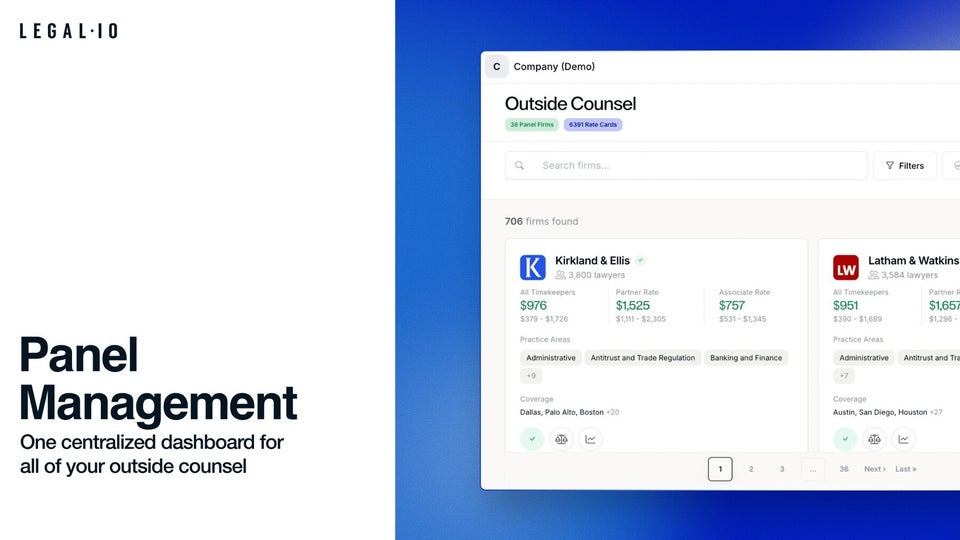
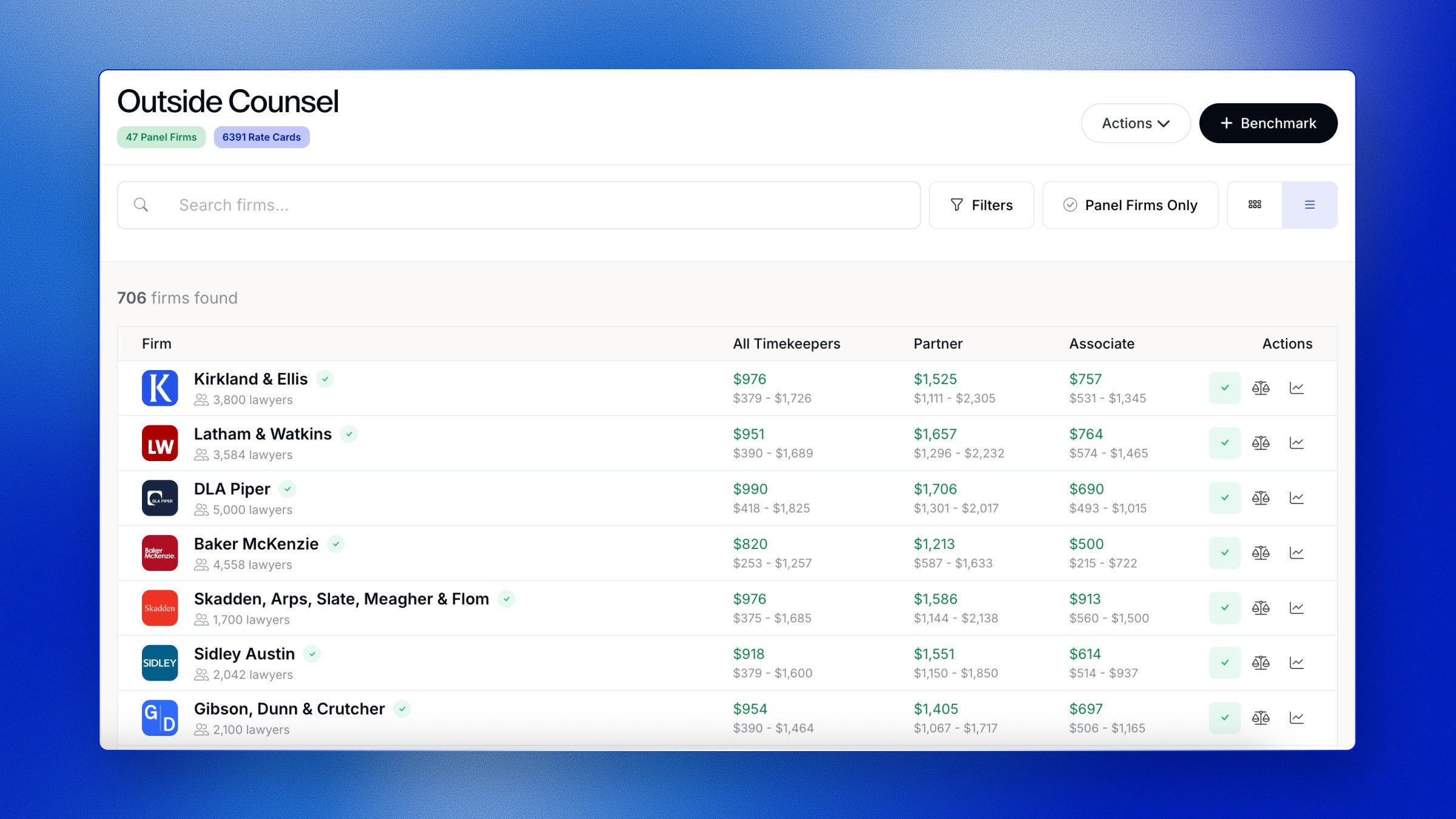
Panel Management gives legal teams a centralized view of their approved firms, making it easier for attorneys to find the right counsel and for operations teams to benchmark and oversee rates.
In-house attorneys find and engage the right firm for a new matter
Panel management helps attorneys answer questions like: "Who should I hire for this?" when hiring outside counsel. It helps them do this without relying on informal channels. They can search the approved panel by practice area, jurisdiction, and firm capabilities to identify the right firm for a specific matter.
It also avoids situations where firms that are better-suited for the task at hand are overlooked. In organizations with panels of up to 50 or more firms that span multiple jurisdictions and practice areas, no single attorney can realistically know the full range of options available to them.
If an attorney needs employment counsel in Malaysia, for example, they can search the directory and see which approved firms cover that jurisdiction and specialty. Previously, this might have meant emailing a few colleagues, waiting for responses, and hoping someone happened to know the right firm.
The result is faster, more consistent engagement with approved firms without relying on guesswork or informal recommendations.
Legal ops validate and benchmark outside counsel rates
Legal operations teams oversee the panel at a structural level. They manage which firms are approved, negotiate billing rates, and ensure the panel provides adequate coverage across practice areas and jurisdictions. A key part of this work is periodic rate review, which typically happens annually or every two years.
These conversations can be sensitive. Many companies have worked with the same firms for years and genuinely value those relationships. The goal isn't usually to drive rates down aggressively. The exercise is simply to confirm that what they're paying is reasonable compared to industry benchmarks. But without reliable market data, legal ops teams are often working from intuition.
Legal.io provides market benchmarks alongside a team's negotiated rate data. Legal ops teams can see where rates fall relative to the typical range for similar work and enter the rate review conversation with an objective foundation. If a firm's rates are above market, the team has the data to decide whether a renegotiation is warranted. If rates are in line, they have the confidence to leave things as they are.
When all panel information lives in a single system, teams can see the full picture of how their panel is structured. They can spot where certain firms are being overused, where gaps exist in jurisdiction coverage, or where multiple firms overlap in the same specialty.
This kind of visibility can also facilitate a broader vendor strategy. It helps legal ops answer questions like: Do we have adequate coverage in Asia-Pacific? Are we too dependent on a handful of firms for our corporate work?
Panel management gives legal ops teams the confidence that their outside counsel rates are aligned with market norms, backed by data they can point to during review cycles.
A smarter approach to legal procurement
With structured and accessible panel data, legal teams stop relying on guesswork, and attorneys find the right firm faster. Legal ops can have rate conversations with outside firms with greater confidence, and decisions across the board are grounded in data rather than habit. That's the value of taking a data-driven approach to panel management.
The same approach applies to the broader legal procurement workflow, from sourcing firms, running RFPs, and managing vendor relationships over time. Legal.io helps in-house legal teams bring these pieces together. It gives teams the tools to source and compare firms, run structured RFPs, track negotiated rates against market benchmarks, and manage vendor relationships over time.
Panel management is where many teams start. But the principle is the same across legal procurement: When teams have the right data, they make better decisions about which firms to hire, what to pay them, and how to manage those relationships over time.
To learn more about how Legal.io supports legal procurement, explore Legal.io's legal procurement tools here.