(Image courtesy of Thomson Reuters)
As the legal industry grapples with the realities of a post-pandemic workforce, many BigLaw firms are reversing their earlier promises of flexible work arrangements, pushing for a return to traditional office settings.
However, this shift is meeting considerable resistance from legal professionals who have grown accustomed to the benefits of remote and hybrid work models. The conflict highlights a broader struggle within the industry to adapt to evolving workplace expectations and maintain employee satisfaction.
The Push for Office Return
Several major law firms have recently announced plans to scale back or eliminate flexible work arrangements, urging lawyers to return to the office. This move contrasts sharply with the remote work policies widely adopted during the height of the COVID-19 pandemic, which were initially celebrated for their potential to reshape the legal workplace for the better.
According to an article on Above the Law, BigLaw firms are finding it increasingly difficult to enforce these return-to-office mandates, many of them resorting to bonus cut threats to get their staff to conform. The pandemic has fundamentally altered workers' expectations, and many legal professionals now prioritize flexibility of the workday and work-life balance more than ever before.
Key Reasons for the Push:
-
Preservation of Firm Culture: Some firms argue that in-person work is essential for maintaining a strong corporate culture and fostering collaboration and mentorship.
-
Client Demands: There is a perception that clients prefer their legal teams to be physically present in the office, believing it ensures better service and availability.
-
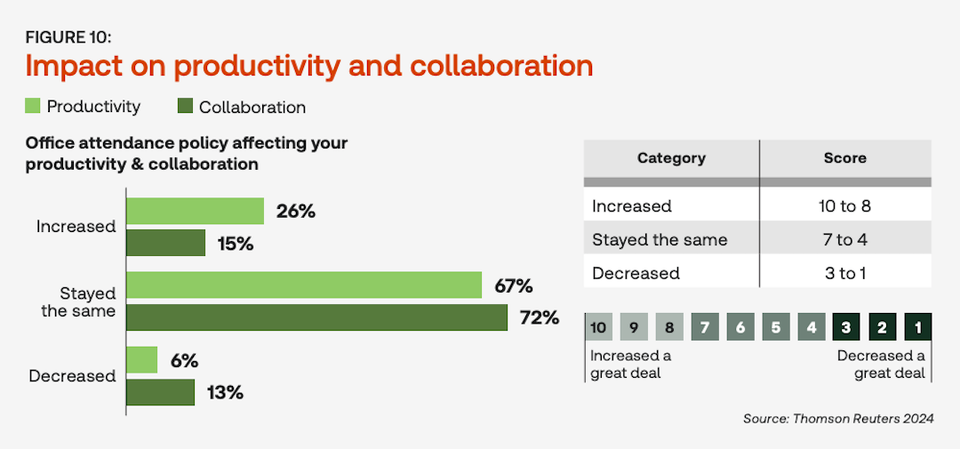
Productivity Concerns: Some leaders believe that productivity and accountability are higher in a traditional office environment.
Why It’s Not Working
Despite these rationales, the push to return to the office is not resonating with today's legal workforce, which overwhelmingly prefers a flexible work environment. Many opponents of the return to office idea feel that this one-size-fits-all approach is about using physical presence as a crutch for leadership and management deficiencies. Instead of adapting to a new era of work and leveraging technology to maintain productivity and collaboration, firms are reverting to old habits, stifling innovation, and ignoring the desires of their talent pool.
Studies show that flexibility in the workplace is directly linked to higher retention and job satisfaction. A study by the Pew Research Center found that 58% of white-collar workers would prefer to work remotely three or more days per week. Similarly, a study published by the scientific journal Nature found that workers with flexible or hybrid work schedules are happier and more likely to stay with their employer longer than their in-office counterparts.
And 56% of respondents to a recent survey said their firm requires lawyers to come in at least three days per week, according to an April report by the Thomson Reuters Institute. The data included 350 responses from 105 U.S. law firms.
Benefits of Flexible Work for Lawyers and Firms
The resistance to returning to the office is not just about personal preference; it also reflects the tangible benefits that flexible work arrangements offer both employees and employers.
For Lawyers:
-
Increased Productivity: Many lawyers report being more productive when working from home, free from the distractions of the office.
-
Reduced Stress: The elimination of commuting and the ability to create a personalized work environment have led to lower stress levels.
-
Better Health and Well-being: Flexible work arrangements have allowed for more time to engage in physical activities and manage mental health better.
For Law Firms:
-
Cost Savings: Reduced need for office space and associated overheads can result in significant cost savings.
-
Broader Talent Pool: Firms can hire talent from a wider geographical area, not limited to those willing to relocate.
-
Enhanced Innovation: Flexibility can lead to increased job satisfaction, which in turn can foster innovation and creativity among legal professionals.
The Industry’s Response
While some firms are doubling down on in-office work, others are embracing the shift towards flexible work models. An article from Reuters highlights how certain U.S. law firms are bucking the trend by promoting fully remote options or virtual offices, recognizing the changing dynamics of the workforce.
The legal industry stands at a crossroads as it navigates the post-pandemic working world. The acceptance of flexible work arrangements is not just a trend but a necessary evolution. Firms that resist this change risk losing out on top talent and falling behind in a competitive market.
Ultimately, the key to success lies in finding a balance that respects the needs of both the firm and its employees. By embracing flexibility and leveraging technology, BigLaw firms can create a work environment that supports both professional excellence and personal well-being, ensuring they remain attractive employers in a rapidly changing world.